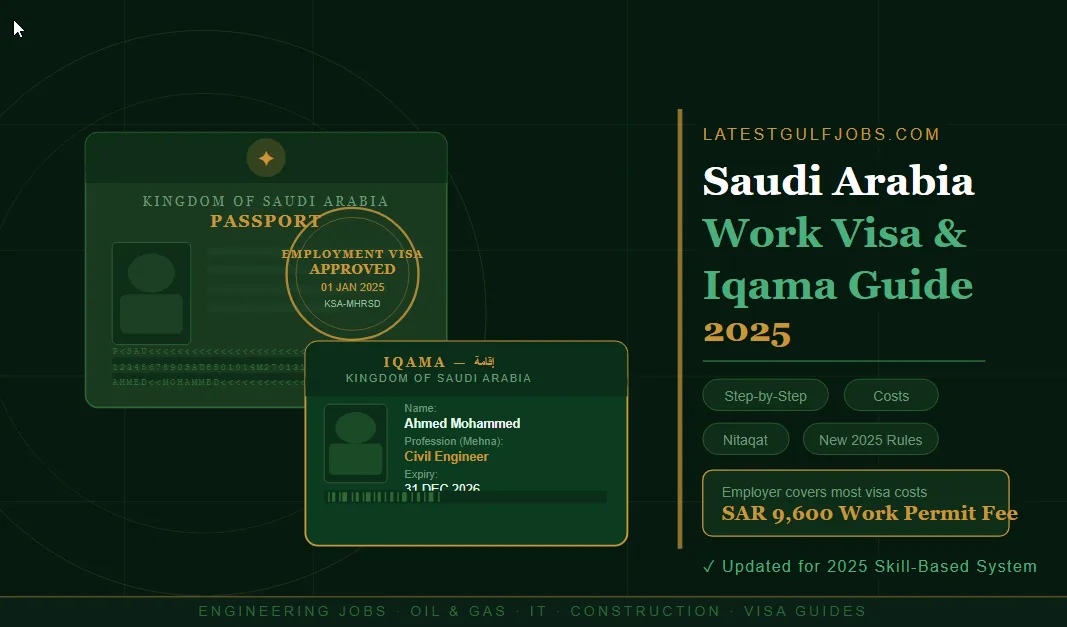
Saudi Arabia Work Visa & Iqama Guide 2025: Complete Step-by-Step for Expat Professionals
By Latest Gulf Jobs Editorial · Updated May 13, 2025 · 16 min read
From initial job offer to receiving your Iqama card — everything engineers, IT professionals, and skilled workers need to know about Saudi Arabia’s new skill-based work permit system, costs, timelines, and how to stay compliant.
Saudi Arabia Work Visa Types: Which One Do You Need?
Saudi Arabia offers several visa categories for foreign workers. Understanding which applies to your situation is the crucial first step — choosing the wrong path can lead to significant delays and legal complications.
| Visa Type | Duration | Who It’s For | Leads to Iqama? |
|---|---|---|---|
| Employment Visa (Work Visa) | 1–2 years (renewable) | Full-time employees with a Saudi employer contract | ✅ Yes — within 90 days |
| Temporary Work Visit Visa (TWVV) | Up to 1 year / 90 days per stay | Short-term projects, consultants, specialists | ❌ No long-term residency |
| Business Visit Visa | Up to 90 days | Meetings, conferences, negotiations | ❌ No — business activities only |
| Premium Residency Visa (Saudi Green Card) | Permanent or annual renewable | High-net-worth individuals (SAR 800K one-time or SAR 100K/yr) | ✅ Full independence — no sponsor needed |
For the vast majority of engineers and professionals relocating to Saudi Arabia for employment, the Employment Visa leading to an Iqama is the correct path. The rest of this guide focuses on this route.
The New 2025 Skill-Based Work Permit System
Saudi Arabia’s Ministry of Human Resources and Social Development (HRSD) overhauled the entire work permit system effective July 2025. This is the most significant change to expat employment rules in over a decade — and every applicant needs to understand it.
The old binary system (“professional” vs “non-professional”) has been replaced with a three-tier skill classification. Your tier determines your eligibility, documentation requirements, and even your ability to switch employers.
Work permits are now issued and renewed based on five criteria: educational background, work experience, professional skills, wage level, and age. Higher-tier workers have greater mobility rights, easier sponsorship transfers, and faster processing. Always ensure your employer classifies you correctly on the Qiwa platform — a mismatch between your registered profession and your actual role now triggers AI-driven compliance audits and fines from SAR 500 to SAR 10,000.
Step-by-Step Saudi Arabia Work Visa Application Process
The process involves coordination between you, your employer, and multiple Saudi government ministries. Here is the complete timeline from job offer to Iqama in hand:
Failing to initiate the Iqama within 90 days of arrival results in fines of SAR 500/day for the employee and significant penalties for the employer. Your employer is legally responsible for this process — but follow up regularly to ensure it happens on time.
Required Documents Checklist
Document preparation is where most delays occur. Have all of these ready before your employer begins the application process — attestation of foreign documents can take 4–8 weeks.
Documents You Need to Provide
- Valid passport with at least 6 months validity (some embassies require 12 months)
- Completed visa application form (provided by Saudi embassy)
- Passport-sized photographs (white background, per Saudi specifications)
- Educational degree certificate — attested by: (a) your local notary, (b) your country’s Ministry of Foreign Affairs, (c) the Saudi embassy in your country, and (d) Saudi Arabia’s Ministry of Foreign Affairs upon arrival
- Professional certifications (PMP, NEBOSH, PE, etc.) — attested similarly
- Medical fitness certificate from an approved clinic
- Police clearance certificate from your home country
- Employment contract signed by both parties
- Visa authorization number from your employer
- Two-way flight ticket confirmation (for some nationalities)
Attestation of your degree is the most time-consuming step. Start this process immediately after accepting a job offer — it typically takes 4–10 weeks from start to finish. Using a professional attestation service in your home country (cost: USD 100–300) can significantly speed this up.
For engineers: most Gulf countries also require verification through the relevant professional engineering body (e.g., Saudi Council of Engineers) for senior roles.
Complete Cost Breakdown: Saudi Work Visa & Iqama 2025
Understanding who pays what is important — Saudi Labor Law places most visa-related costs on the employer, but employees typically cover personal document costs and travel expenses.
| Fee / Cost | Amount | Paid By |
|---|---|---|
| Work Permit (Qiwa platform) | SAR 800–9,600/year | Employer (varies by Nitaqat band) |
| Iqama Issuance Fee | SAR 51.75 (~$14) | Employer |
| Iqama Annual Renewal | SAR 57.75 (~$15) | Employer |
| Embassy Visa Fee | USD 80–200 | Employee (usually) |
| Medical Examination (home country) | USD 50–100 | Employee |
| Medical Examination (in KSA) | USD 60–120 | Often employer |
| Document Attestation | USD 100–400 total | Employee |
| Dependent Family Iqama Levy | SAR 300–400/month per dependent | Employee (employee’s responsibility) |
| Health Insurance (mandatory) | USD 100–300/year | Usually employer-provided |
| Sponsorship Transfer (1st) | SAR 2,000 (~$533) | New employer pays |
| Premium Residency (permanent) | SAR 800,000 (~$213,000) | Individual applicant |
Most expat professionals spend USD 350–800 in personal costs to complete the full visa and Iqama process — covering medical exams, document attestation, and the visa fee. Employers cover all other major costs under Saudi Labor Law. Always clarify the cost split in your contract.
Your Iqama: What It Is and How to Manage It
The Iqama is the most important document you will hold in Saudi Arabia. It is your official residency and identity permit — and you must carry it at all times. Losing it or allowing it to expire has serious consequences.
What Your Iqama Gives You Access To
- Legal right to live and work in Saudi Arabia for your employer
- Open a Saudi bank account (SABB, Al Rajhi, SNB, etc.)
- Rent accommodation in your own name
- Access healthcare at Saudi hospitals and clinics
- Apply for a Saudi driving license
- Sponsor dependent family members (spouse + children)
- Apply for exit/re-entry permits and manage travel
- Access government digital services via Absher and Muqeem platforms
Checking and Managing Your Iqama Online
Saudi Arabia has digitized most Iqama services. You can check your Iqama status, verify your profession code (Mehna field), renew remotely, and manage exit/re-entry permits through:
| Platform | What You Can Do | Access |
|---|---|---|
| Absher (أبشر) | Iqama renewal, exit permits, family services, profession check | Mobile app or absher.com.sa |
| Muqeem (مقيم) | Work permit management, employer actions, remote extensions | muqeem.sa |
| Qiwa (قوى) | Skill classification, labor contract registration, transfers | qiwa.com.sa |
| Ministry of Interior (MOI) | Profession verification, residency status | moi.gov.sa |
Your Iqama must be renewed before it expires. Fines for late renewal are structured and cumulative. First violation: fine equal to renewal fee. Second: double. Third: risk of deportation. Set calendar reminders 30 days before your Iqama expiry date and alert your employer/HR department immediately.
Nitaqat (Saudization): How It Affects Your Employment
The Nitaqat program mandates that Saudi employers maintain a minimum ratio of Saudi national employees relative to their total workforce. Your ability to get a work permit — and your employer’s ability to sponsor you — depends heavily on where their company sits in the Nitaqat colour-band system.
| Nitaqat Band | Saudi Employee % | Impact on Expat Hiring |
|---|---|---|
| 🟢 Platinum / High Green | Above target | Maximum visa allocations, fast processing |
| 🟢 Medium Green | At or near target | Standard visa rights, normal processing |
| 🟡 Low Green | Slightly below | Reduced quota, some restrictions |
| 🔴 Yellow / Red | Well below target | Cannot sponsor new expats, visas suspended |
Before signing any employment contract, ask your HR contact to confirm the company’s current Nitaqat status. A company in a Red or Yellow band cannot legally issue you a work permit — even if they have made you a job offer.
Expert Tips to Avoid Common Visa Mistakes
Before You Leave Your Home Country
- Start document attestation immediately — it is always the biggest delay
- Verify your employer’s Nitaqat status and commercial registration number
- Get everything in your employment contract in writing — benefits, allowances, Iqama responsibility
- Apply early (2–3 months before your planned start date) to account for peak-season embassy delays (particularly post-Ramadan and Hajj season)
- Check if your nationality faces any immigration holds — 14 nationalities including Pakistani and Indian nationals may face seasonal processing delays, particularly May–June during Hajj
After You Arrive in Saudi Arabia
- Follow up with your HR department weekly on Iqama progress — they often manage many employees and your file can be delayed
- Register on Absher within the first week of arrival
- Ensure your Iqama profession (Mehna) exactly matches your actual job title — AI audits now flag mismatches and this can affect your employment status
- Keep digital copies of all documents in cloud storage
- If changing employers (sponsorship transfer), ensure your current sponsor grants legal release first — illegal transfer is a deportation risk
Find Your Next Role in Saudi Arabia Today
Browse verified engineering, oil & gas, IT, and construction vacancies from top KSA employers — with full salary and benefits details.
Browse Saudi Arabia Jobs →